
Buying new equipment is not always the best financial decision for a dental practice. However, buying the cheapest option is not always smart either. For many dentists, refurbished dental equipment can offer a way to upgrade the practice while keeping more cash available for daily operations.
At the same time, refurbished equipment comes with important questions. How reliable is it? Does it include a warranty? Will it work with your current technology? Most importantly, will the savings justify the potential risks?
In 2026, dental practice owners have more equipment choices than ever. Therefore, comparing new and refurbished equipment before making a purchase can help you protect your cash flow and make a better long-term investment.
What Is Refurbished Dental Equipment?
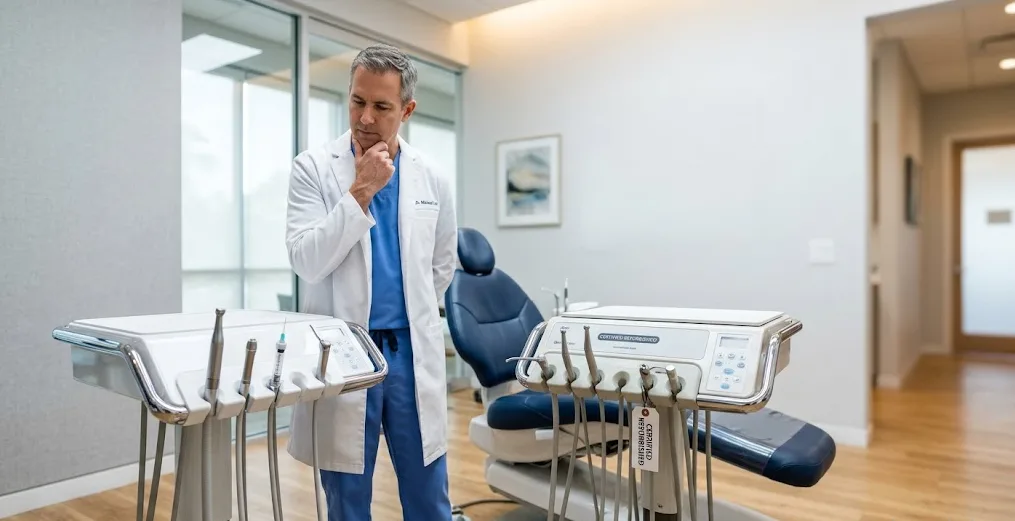
Refurbished dental equipment is previously owned equipment that has been inspected, repaired, cleaned, tested, or restored before being sold again.
However, not every refurbished product is the same.
Some equipment may have been lightly used and professionally restored. Other items may have undergone major repairs or replacement of important parts. Because of this, the seller’s reputation and refurbishment process matter.
Before purchasing, ask:
- What was repaired or replaced?
- Was the equipment professionally tested?
- How old is the equipment?
- Is documentation available?
- Does it include a warranty?
- Are replacement parts still available?
- Is installation included?
Getting clear answers can help you avoid unexpected costs later.
Why Dentists Consider Used Dental Equipment
The biggest reason dentists consider used dental equipment is simple: price.
Refurbished equipment can sometimes cost significantly less than comparable new equipment. As a result, practices may be able to access technology that would otherwise be outside their immediate budget.
For a growing practice, that difference can matter.
Instead of using all available cash on one purchase, a dentist may be able to allocate funds toward several business needs. For example, the practice could upgrade equipment while also maintaining cash reserves for payroll, supplies, marketing, or unexpected repairs.
Nevertheless, lower purchase prices should not be the only consideration.
The goal is not to find the cheapest equipment. The goal is to find equipment that delivers the best overall value.
The Pros of Refurbished Dental Equipment
There are several reasons refurbished equipment can make financial sense.
Lower Upfront Cost
The most obvious advantage is a lower purchase price.
When a reputable seller restores equipment to good working condition, the practice may receive useful technology at a lower cost than buying new.
That can make it easier for smaller practices to upgrade without putting excessive pressure on their budget.
Faster Access to Technology
Waiting to save enough cash for new equipment can delay improvements for months or even years.
With refurbished equipment, a practice may be able to adopt useful technology sooner.
For instance, upgrading an imaging system could improve diagnostic workflows and patient communication. Similarly, a refurbished treatment chair could replace an unreliable unit before frequent repairs become a bigger problem.
Potentially Strong ROI
A lower acquisition cost can improve dental equipment ROI.
Suppose a new piece of equipment costs $80,000 while a comparable refurbished unit costs $50,000. If both can support similar production and the refurbished unit meets your clinical needs, the lower initial investment may allow you to reach your break-even point sooner.
However, the purchase price alone does not determine ROI.
Maintenance, downtime, training, installation, warranties, and expected useful life must also be included.
The Cons of Refurbished Dental Equipment
Refurbished equipment can be a smart choice, but it is not risk-free.
Shorter Remaining Lifespan
Older equipment may have fewer useful years remaining than a new model.
Therefore, a lower purchase price may not actually represent a better deal if the equipment needs replacement again soon.
Before buying, estimate how long you expect the equipment to remain productive.
Repairs and Maintenance
Older equipment may require more maintenance.
Replacement parts can also become difficult to find when manufacturers discontinue older models.
For that reason, ask the seller about parts availability and expected maintenance needs before purchasing.
Limited Features
Technology changes quickly.
A refurbished system may work well but lack features found in newer models.
That difference may matter if your practice wants to integrate new digital workflows or expand into additional services.
Warranty Differences
New equipment often comes with manufacturer warranties. Refurbished equipment may have a shorter warranty or a warranty provided only by the seller.
Always review the warranty before making a decision.
A lower purchase price becomes less attractive if one major repair eliminates the initial savings.
New vs. Refurbished Dental Equipment: Which Is Better?
There is no universal answer.
The right choice depends on your practice, the equipment category, your budget, and how important the technology is to your workflow.
New equipment may be the better choice when:
- You need the latest technology.
- The equipment is critical to daily production.
- You expect heavy use.
- You want a longer warranty.
- You plan to keep the equipment for many years.
Refurbished equipment may make more sense when:
- The technology is proven and reliable.
- The savings are significant.
- The equipment has been professionally restored.
- Replacement parts are readily available.
- The warranty provides reasonable protection.
In other words, the decision should be based on total value rather than the sticker price.
Calculate Total Cost of Ownership
One of the biggest mistakes dentists make is comparing only purchase prices.
Instead, calculate the total cost of ownership.
This includes:
- Purchase price
- Installation
- Shipping
- Training
- Maintenance
- Repairs
- Replacement parts
- Software fees
- Downtime
- Expected useful life
For example, a refurbished system costing $40,000 may initially look much better than a new $65,000 system.
However, if the refurbished system requires $12,000 in repairs over several years and must be replaced sooner, the difference may become much smaller.
On the other hand, if the refurbished system performs reliably and requires minimal maintenance, the savings could be substantial.
Therefore, compare the complete financial picture before deciding.
When Paying More Upfront Can Save Money
Sometimes, buying new is actually the more financially responsible decision.
A newer system may cost more initially, but it could provide:
- Longer useful life
- Better warranty coverage
- Lower maintenance costs
- Improved efficiency
- Better integration with other technology
- Access to manufacturer support
For equipment that directly affects production, these advantages can have a significant financial impact.
Consider a digital system that allows your practice to complete procedures faster. If the additional production consistently exceeds the higher equipment cost, paying more upfront could generate a stronger long-term return.
That is why the cheapest option is not necessarily the most profitable option.
Which Dental Equipment Is Worth Buying Refurbished?
Some equipment categories may be easier to purchase refurbished than others.
Treatment chairs, dental lights, delivery systems, sterilization equipment, and certain imaging systems may offer attractive opportunities when professionally restored.
However, the decision depends heavily on the equipment’s age, condition, support, and technology.
For highly specialized or rapidly changing technology, buying new may provide greater value.
For example, if a new system offers substantially better imaging, workflow integration, or clinical capabilities, the additional investment may be justified.
Ultimately, evaluate each purchase individually rather than applying the same rule to every piece of equipment.
How Financing Changes the Decision
Financing can change the comparison between new and refurbished equipment.
Some dentists assume financing only makes sense for expensive new technology. However, financing can also help practices preserve working capital when purchasing qualified refurbished equipment.
Instead of using a large amount of cash at once, financing may allow the practice to spread the cost over time.
That can help preserve funds for:
- Payroll
- Supplies
- Marketing
- Emergency expenses
- Other equipment
- Practice expansion
However, financing should still be evaluated carefully. Interest and financing costs increase the total amount paid, so the expected return should justify the investment.
How to Compare Financing Options
When comparing equipment financing options, don’t focus only on the monthly payment.
Look at the full structure.
Consider:
- Interest rate
- Repayment term
- Total repayment amount
- Fees
- Payment schedule
- Prepayment terms
- Equipment eligibility
A lower monthly payment may look attractive, but a longer repayment period can increase the total cost.
On the other hand, a slightly higher payment could help you pay off the equipment faster and reduce total interest.
The right structure depends on your practice’s cash flow and goals.
Questions to Ask Before Buying Refurbished Equipment
Before purchasing refurbished dental equipment, ask the seller for detailed information.
Equipment History
Find out how old the equipment is, how heavily it was used, and why it was replaced.
Refurbishment Process
Ask what parts were replaced and what testing was performed.
Warranty
Confirm what the warranty covers and how long it lasts.
Service and Parts
Make sure replacement parts and qualified technicians are still available.
Installation
Determine whether installation, calibration, and training are included.
Compatibility
Check whether the equipment works with your existing systems and workflow.
These questions can reveal potential costs before you commit.
Don’t Forget the Cost of Downtime
Equipment downtime can be more expensive than expected.
If a critical piece of equipment stops working, the practice may need to reschedule patients, delay treatment, or refer cases elsewhere.
Consequently, reliability should be part of your ROI calculation.
A slightly more expensive system may be worthwhile if it significantly reduces downtime.
Similarly, a refurbished unit with a strong service agreement may provide more financial protection than a cheaper unit with limited support.
When Refurbished Equipment Makes Financial Sense
Refurbished equipment can be a strong choice when the savings are meaningful, the equipment is reliable, and the practice has a clear plan for using it.
For example, a growing practice may choose refurbished equipment to add another operatory without using a large portion of its cash reserves.
Meanwhile, an established practice may prefer new equipment for technology that directly impacts high-value procedures.
In both cases, the decision should start with the practice’s goals rather than the equipment’s price.
How IMS Financial Can Help
At IMS Financial, we understand that every dental practice has different equipment needs and financial goals.
Whether you’re considering new or refurbished equipment, the financing structure can have a major effect on your practice’s cash flow.
Our financing solutions can help dental professionals evaluate equipment purchases while keeping working capital available for other business needs.
If you’re considering an equipment investment, explore our dental equipment financing solutions or learn more about financing options for dental professionals.
The goal is not simply to finance equipment. It is to help you choose a financial strategy that supports the way your practice plans to grow.
Final Thoughts
So, should you buy refurbished dental equipment in 2026?
Sometimes, yes.
A professionally refurbished system can offer substantial savings and a strong return on investment. However, a lower purchase price does not automatically make equipment a better investment.
Before buying, compare the total cost of ownership, expected lifespan, maintenance needs, warranty, downtime risk, and potential production gains.
Most importantly, consider what the equipment will help your practice accomplish.
The best equipment investment is not necessarily the newest or the cheapest. It is the one that delivers reliable performance, supports your clinical goals, and makes financial sense for your practice.
For some dentists, that will mean buying refurbished. For others, paying more for new technology will create greater long-term value. The key is making the decision based on numbers rather than assumptions.
👉 Explore our financial planning resources for dental practices and start the year with confidence.
👉 Learn more to receive additional information about flexible financing solutions for dental practices.
👉 Read our client stories to see how other dental practices have navigated similar financial challenges.


